
 Introduction: Why the Price of Pashmina Raises Questions
Buyers exploring luxury shawls often encounter a wide range of prices attached to products labelled “Pashmina,” which naturally leads to one important question: why is pure Pashmina expensive? The confusion usually arises because many machine-made or blended products are marketed under the same name, creating unrealistic expectations around pricing.
Pure Pashmina, however, belongs to an entirely different category. Its price reflects rare natural fibre, manual processes that cannot be industrialised, and craftsmanship refined over generations. Understanding these factors allows buyers to evaluate authenticity accurately, avoid imitation products, and make confident purchasing decisions—especially when shopping online.
Why Pure Pashmina Is Expensive?
Pure Pashmina is expensive because it is made from a rare ultra-fine natural fibre that is available only in limited quantities, processed manually, and handwoven using traditional methods. It cannot be mass produced, improves with age, and offers decades of comfort and durability. Lower-priced alternatives are typically blended or machine-made and do not offer the same performance or longevity.
What “Expensive” Means in the Context of Pashmina
In the world of Pashmina, “expensive” does not imply inflated or trend-driven pricing. Instead, it reflects value-based pricing rooted in scarcity, labour intensity, and long-term usability. Authentic Pashmina is produced in limited quantities each year and cannot be scaled through automation without losing its defining qualities.
Unlike fast-fashion accessories designed for frequent replacement, pure Pashmina is created to last for decades. Its price justifies for longevity, comfort, and timeless relevance rather than short-term fashion cycles.
The Rarity of Pashmina Fibre
One of the most significant contributors to the high cost of pure Pashmina is the scarcity of the raw fibre. Pashmina wool comes from the ultra-fine undercoat of high-altitude Himalayan goats that develop this fleece naturally to survive extreme cold.
The fibre is collected only during specific seasons, yields are limited per animal, and quality varies. Because supply cannot be increased through industrial farming or synthetic replication, genuine Pashmina remains inherently rare, placing it firmly in the luxury segment from the very first stage of production.
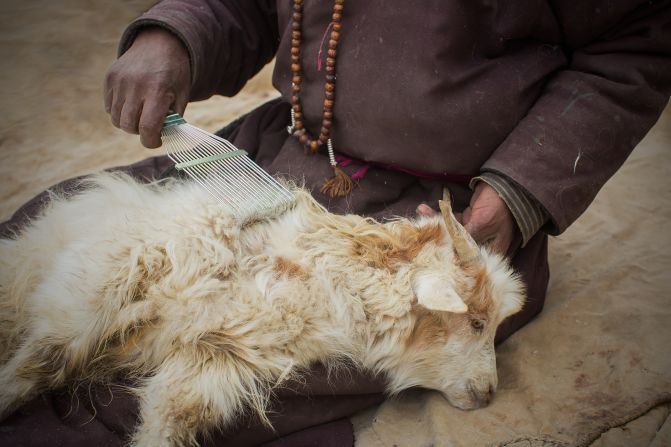 Image Source: From the Internet
Manual Collection and Fibre Preparation
Pure Pashmina is not harvested through aggressive shearing. Instead, it is collected during the natural moulting period, after which the fibre undergoes careful cleaning and manual sorting. Only the finest strands are selected for premium weaving, while coarser fibres are discarded or diverted for lower-grade uses.
This meticulous selection process is labour-intensive and significantly reduces usable yield, but it is essential to achieving the softness, lightness, and performance associated with authentic Pashmina. The reduced output directly influences pricing.
Hand-Spinning: Why Machines Cannot Replace Human Skill
The ultra-fine nature of Pashmina fibre makes it unsuitable for high-speed industrial spinning. Mechanical tension can damage the fibre, compromising softness and strength. To preserve integrity, yarn is traditionally hand-spun, a slow process that requires experience and precision.
Hand-spinning maintains fibre alignment and softness while preventing breakage. Producing enough yarn for a single shawl can take several days, adding time and skilled labour costs that machine-spun substitutes simply do not incur.
Handwoven Craftsmanship and Time Investment
Authentic Pashmina is handwoven on traditional looms, where artisans manually control weave density, tension, and alignment. This careful approach produces fabric that is breathable yet durable, light yet warm.
While machine-made shawls can be produced in hours, a handwoven Pashmina shawl can take weeks to complete. This extended production timeline reflects the level of craftsmanship involved and is a core reason original Pashmina shawls command premium prices.
Why Pure Pashmina Cannot Be Mass Produced
Mass production relies on uniform, strong fibres that can withstand speed and mechanical stress. Pure Pashmina does not meet these requirements, which is why machine-made “Pashmina” products are usually blends or substitutes.
Authentic Pashmina’s inability to be mechanised at scale is not a limitation—it is the reason it remains exclusive. The warmth-to-weight ratio, breathability, and graceful ageing of pure Pashmina cannot be replicated through industrial shortcuts.
How GI Recognition Adds Value to Pure Pashmina
Kashmiri Pashmina has Geographical Indication (GI) recognition, which exists to protect traditional methods and regional identity. GI recognition helps distinguish authentic Pashmina from generic “Pashmina-style” products and reinforces the link between material quality, craftsmanship, and origin.
While GI tagging should be considered alongside other authenticity indicators, it adds value by supporting heritage preservation, protecting artisanship, and reinforcing Pashmina’s premium positioning in the global market.
Also Read: What Does GI-Tagged Pashmina Mean?
Limited Production Scale and Non-Scalability
Every stage of pure Pashmina production—fibre collection, spinning, weaving, and finishing—depends on skilled human labour. This non-scalable production model naturally limits output and maintains exclusivity.
Because supply cannot be rapidly increased to meet demand, authentic Pashmina retains its value over time, unlike mass-produced textiles that are subject to price erosion.

Why Pashmina Prices Vary So Much Online
One of the most common sources of confusion for buyers researching Pashmina online is the wide variation in prices. A search for Pashmina shawls can reveal products priced anywhere from a few thousand rupees to significantly higher amounts, all using similar terminology. This disparity often leads buyers to question whether higher-priced Pashmina is genuinely worth the cost or whether lower-priced options offer comparable value.
The primary reason for this variation lies in the difference between authentic Pashmina and imitation products. Many online listings labelled as “Pashmina” are actually made from blended fibres, viscose, wool, or synthetic materials. These substitutes are cheaper to source, easier to machine-produce, and can be manufactured in large volumes, allowing sellers to offer lower prices while still using the Pashmina name.
In contrast, pure Pashmina involves a cost structure that cannot be replicated through industrial shortcuts. The fibre itself is rare and seasonally collected, followed by labour-intensive hand-spinning and handweaving processes. Each of these stages adds genuine production cost, which is reflected in the final price. As a result, authentic Pashmina maintains relatively consistent premium pricing across credible sellers, even online.
Another factor contributing to price variation is lack of transparency in product descriptions. Vague terms such as “Pashmina feel,” “Pashmina-style,” or “soft wool Pashmina” are often used to market blended or imitation products without explicitly stating material composition. These listings may appear visually similar in photographs but differ significantly in comfort, durability, and long-term performance.
Price variation can also arise from differences in craftsmanship. Handwoven Pashmina requires skilled artisans and extended production timelines, whereas machine-made alternatives prioritise speed and volume. The latter can be sold at lower prices but do not offer the warmth-to-weight ratio, breathability, or graceful ageing associated with genuine Pashmina.
For online buyers, understanding these distinctions is critical. Rather than comparing prices alone, evaluating material integrity, weaving method, brand focus, and transparency provides a more accurate measure of value. Brands that specialise exclusively in Pashmina are generally better positioned to maintain authenticity standards than platforms where Pashmina is just one of many unrelated products.
At Pashmsutra, pricing reflects a commitment to authentic Pashmina craftsmanship rather than market-driven discounting. By focusing on fibre quality, traditional methods, and honest product communication, the brand aims to remove ambiguity for buyers and ensure that price corresponds to genuine material and workmanship rather than misleading labels.
In essence, Pashmina prices vary online because not all products sold under the same name are truly comparable. Recognising the difference between authentic Pashmina and mass-produced substitutes allows buyers to look beyond price tags and make informed decisions based on long-term value rather than short-term cost.
| Aspect | Pure Pashmina | Machine-Made / Blended |
|---|---|---|
| Fibre | Ultra-fine natural | Wool, viscose, or synthetic |
| Production | Hand-spun and handwoven | Machine-made |
| Warmth | High, lightweight | Heavier, less breathable |
| Longevity | Decades with care | Few seasons |
| Price | Premium | Low to mid-range |
Sustainability and Ethical Value
Pure Pashmina aligns naturally with conscious luxury. It uses natural fibres, limited quantities, and low-impact manual processes rather than energy-intensive industrial manufacturing. Investing in one high-quality Pashmina piece often replaces multiple lower-quality alternatives, adding ethical value alongside comfort and elegance.
Buying Pure Pashmina with Confidence
When you buy genuine Pashmina online, evaluate fibre details, weaving method, transparency, and realistic pricing. Brands that specialise exclusively in Pashmina tend to prioritise authenticity over volume. At Pashmsutra, the focus remains on material integrity and traditional craftsmanship, allowing buyers to invest confidently in authentic pieces.
Written by the Pashmsutra editorial team, specialists in authentic Kashmiri Pashmina and traditional craftsmanship.


